Eight short chapters from real construction projects. Real screens, real numbers, names changed. No signup. Read it in fifteen minutes.
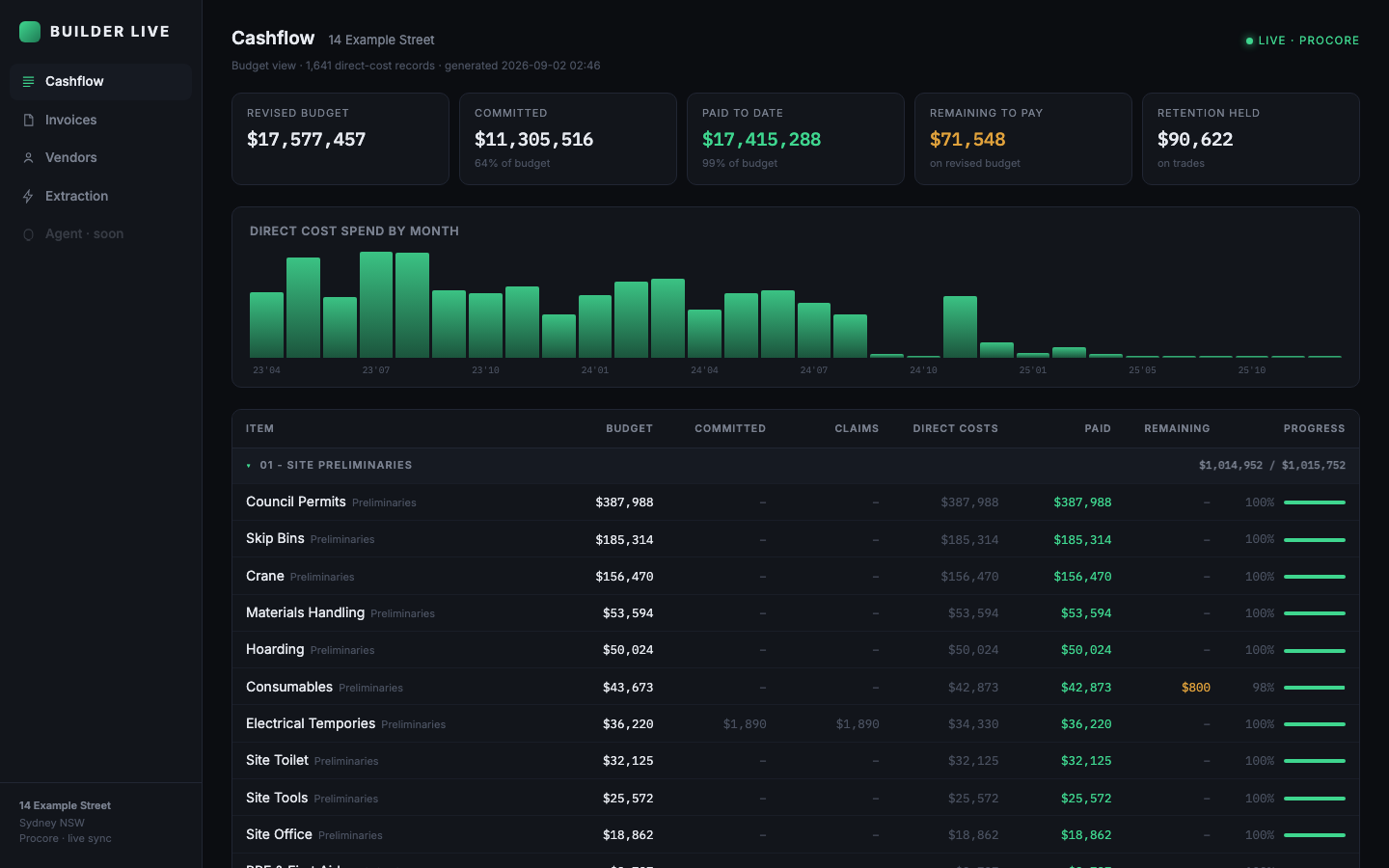
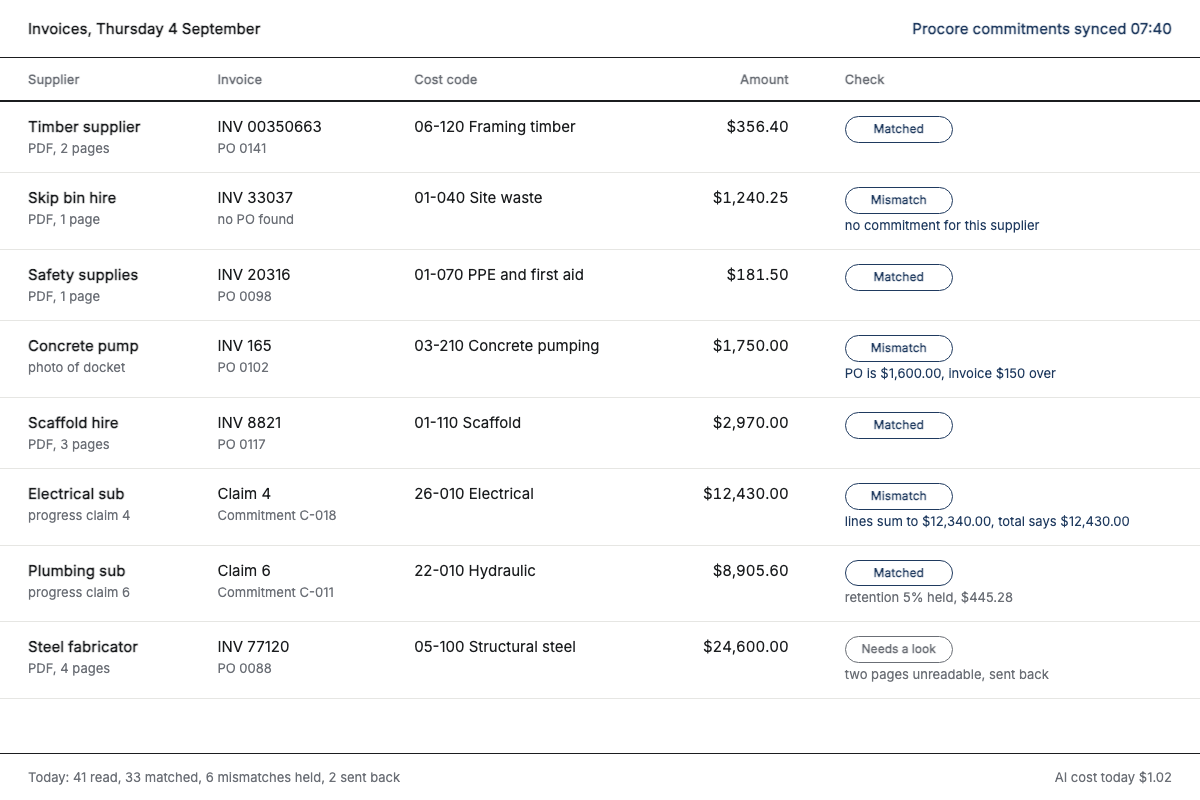
A supplier invoice is a PDF, a photo of a docket, or a three-page progress claim with retention on the last line. A vision model reads all of them and returns lines: description, quantity, unit, price, GST. On one project it read 1,641 invoices, 5,405 lines, for $40.55 in model cost. About 90 percent were clean on the first pass.
What breaks: progress claims, where the number you want is rarely the biggest on the page, and GST, where suppliers are inconsistent about whether unit prices include it. Normalise everything to ex GST and flag any invoice where the GST line is not ten percent of the total.
Reading is the model's job. Checking is arithmetic, and arithmetic belongs in code. Do the lines add up to the total? Does the total match the Procore commitment or PO? Is there a commitment for this supplier at all? Three checks, run on every invoice, and the ones that fail are held with the reason written next to them.
On that same project: 81 invoices where Procore did not match the PDF, 12 where the supplier's own lines did not add up. Two of those were overcharges. Nothing had been paid twice, but nobody had known that either.
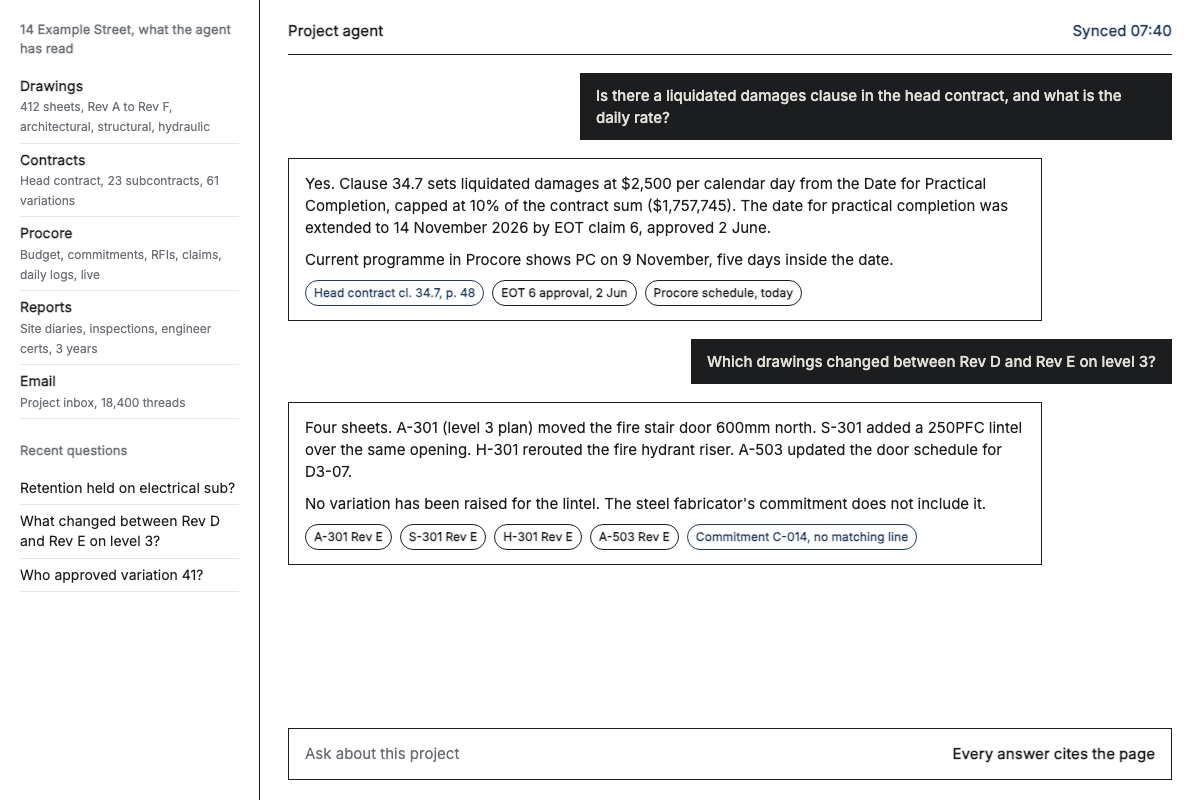
Once the drawings, contracts, claims, reports and Procore records are indexed, a question in the project channel gets an answer with the source. What does the contract say about delay. Which sheets changed between Rev D and Rev E. Who holds the ball on RFI 41. Every answer cites the page, so checking takes one click.
This is the part builders underestimate. The project manager is the search engine for the whole job. Give the team a way to ask, and the afternoon comes back.
RFIs, change orders and daily logs are written by hand from things that already exist: a photo, an email, a drawing. The assistant drafts them from those sources. A photo of a lintel with no variation becomes RFI 119, with the sheet referenced and the ball in court set. The draft waits. A person approves.
Rule that keeps this safe: it never sends, never approves, never changes a record. Drafts only. The moment you let it write unsupervised, you have a confident machine making mistakes at speed.
Scanned image-only PDFs with no text layer are indexed but weak. Photos of dockets taken in a ute at dusk. Faxed statements. Excel read as data, not formulas. A cost code renamed halfway through a project, where the model cannot know which name is current unless told.
The fix is not a better model. It is a confidence threshold and a queue. Below the threshold, it says so and hands the document to a person with the image alongside. On the 1,641 run, 37 went that way. That is the system working.
Your documents stay in your accounts. Voice notes are transcribed on our own server, nothing sent out. The model providers we use have terms that exclude training on your data. For sensitive projects the whole thing runs inside your own cloud account and nothing leaves it.
Ask any vendor three things: where does the document go, who can see the answer, and is anything used to train a model. If they cannot answer in one sentence each, that is the answer.
Pick the workflow you can time. Invoices from inbox to approved. Three real questions from ask to answer. Month end from start to closed. Time it on day one, run the system for two weeks on one live project, time it again on day fourteen. If it is not half, do not pay.
Most builders start with invoices, because the hours are the easiest to measure and the errors are the most expensive. Second is the assistant, because the project manager feels it on day three.
Model usage is cents. Reading an invoice costs about two and a half cents. Answering a question costs less than a cent. The real cost is the person who keeps it running through supplier format changes and Procore updates, and that is a fixed monthly fee, not a per-seat licence.
Beware per-seat pricing for a tool the whole site office should be able to ask. And beware anyone who tells you to leave Procore to fix paperwork. They are selling a platform.
Seven questions, one minute, your AI plan on the page. Or bring one document to the monthly clinic.
Get my free AI plan